
Interpreter Pricing Guide: How Quotes Are Built

Interpreters in Indonesia are booked by the hour, the half day or the full day, in consecutive, simultaneous or remote form. The mode and the hours decide most of the fee, so they are the first two things to settle. This guide explains how a quotation is built, what can be added to it and why two quotes for the same day can differ, so you can plan a budget and send a clear brief. We do not publish prices; fees are on request and confirmed in writing.
Still planning? You can ask for an initial estimate before the date is fixed. Share the month or date range if you know it. Availability and the final quotation are confirmed separately.
Consecutive or simultaneous interpretation?
Consecutive: the speaker pauses and the interpreter renders each part. It needs no equipment and suits meetings, negotiations, interviews, site visits and small online calls. It adds time to every exchange, so plan the agenda for it.
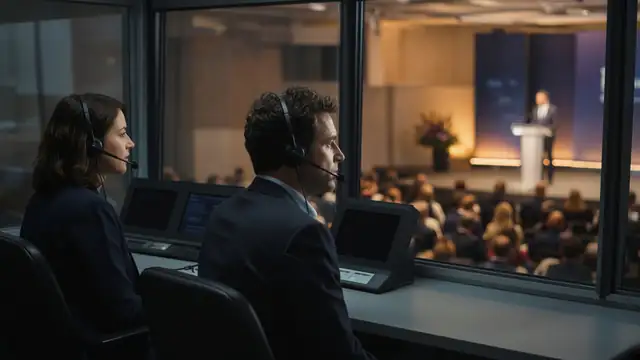
Simultaneous: the interpreter speaks at the same time as the speaker, from a booth, and the audience listens on receivers. It suits conferences, plenaries and long webinars. Simultaneous interpreters work in pairs and take turns, so a booking is for a team, not one person. The venue or an AV supplier arranges the booth and receivers; we do not rent equipment. More on simultaneous interpreters.
Hourly, half-day or daily?
An hourly booking suits a single meeting or a short call. A half-day or full-day booking suits a programme of meetings, a conference day or a site visit, and usually works out simpler than adding hours. A day booking covers a set block of working hours agreed in the proposal; extra time is agreed before the day, not after.
Travel time between meetings, and travel to another city, count as part of the booking. If the interpreter must stay overnight, accommodation is a separate line.
What changes the fee
The language pair, the mode, the hours per day, the number of days, the subject matter and the preparation needed. Technical, legal or medical subjects need more preparation. A request with flexible dates can also give you more choice of interpreters.
- Language pair and direction (both ways is normal)
- Consecutive or simultaneous
- Hours per day and number of days
- Onsite city, travel and overnight stays, or online
- Subject and preparation material
Working hours, breaks and overtime
A day booking covers an agreed block of working hours with breaks. Consecutive interpreters need regular pauses over a long day; simultaneous interpreters work in pairs and take turns, which is why a simultaneous day is booked for a team. Time beyond the agreed block is overtime and is agreed before the day where possible. If the programme may run long, say so in the brief.
Preparation
Every assignment needs some preparation: reading the agenda, names, slides and terminology. For a short general meeting it is part of the booking. For technical, legal, medical or academic subjects, or a long programme, preparation can be significant and may be quoted as its own line. Sending materials early improves the result more than anything else you can do.
Travel, accommodation and moving between cities
Travel time between meetings counts as working time. Travel to another city or island, overnight stays and meals on the road are separate lines. A programme that moves cities, such as a business delegation or factory visit in Java, also lists the vehicle, driver, fuel and tolls on their own lines.
Equipment
Consecutive interpretation needs no equipment. Simultaneous interpretation needs a booth, consoles and receivers, usually from the venue or an AV supplier; it is quoted separately from the interpreters. For remote interpretation your side hosts the meeting and the platform. The quotation says who supplies what.
Consecutive, simultaneous or remote
Consecutive suits meetings, negotiations and visits, and is usually priced per interpreter for the agreed hours. Simultaneous suits conferences and is priced for a team, plus equipment. Remote interpretation on Zoom or Teams is priced for the session time and a short connection check beforehand. See online interpreters.
Why two quotes for the same day can differ
Two requests that look alike can be quoted differently because of the language pair and direction, the subject, the amount of preparation, the length of the day, travel, the notice period, and whether one interpreter or a team is needed. A quote that looks cheaper may leave out preparation, travel or overtime, so compare the lines rather than the total.
How a quotation is built
Our written quotation lists each part so you can see what you are paying for:
- Professional fee for the agreed hours or days
- Preparation and coordination, where significant
- Travel, accommodation and meals, where the interpreter travels
- Equipment or other suppliers, where needed
- Agency fee and applicable taxes
Estimate, availability check and confirmed booking
An initial estimate helps you plan a budget before the date is fixed. An availability check asks specific interpreters about a specific date. A booking is confirmed only in writing, with the agreed hours, lines and terms. We always tell you which of these you have. For speakers, see how speaker fees work.
What to send for a quote
- Language pair, for example Arabic–English, Mandarin–Indonesian or Russian–English
- Consecutive or simultaneous (or say you are not sure)
- Onsite or online (Zoom, Teams), and the city and venue if onsite
- Date or dates, start time and time zone
- Hours per day and number of days
- What the meeting is about, and any documents or names to prepare
Speakers Indonesia is run by the team behind myCHEF Bali (mychef.id), so every enquiry, meeting and booking is handled by a dedicated client team — not passed straight to the talent.
We come back with 2–3 vetted candidates for the role. Fees are on request and depend on the brief.
5 results
Consecutive & Business Meeting Interpreter (English–Indonesian), Jakarta & Bali
Interpreters for meetings, negotiations, interviews and site visits, no booth needed.
2–3 vetted candidates
Fee: On request
What you get: 2–3 matched candidates
Simultaneous Conference Interpreter (English–Indonesian), Jakarta
Booth interpreters for conferences and forums, usually working as a team of two.
2–3 vetted teams
Fee: On request
What you get: 2–3 matched candidates or teams
Conference & Event Interpreter, Bali
Simultaneous and consecutive interpreters for conferences, MICE groups and events in Bali.
2–3 vetted candidates
Fee: On request
What you get: 2–3 matched candidates
Delegation & Site-Visit Interpreter (Accompanying), Bali & Jakarta
Interpreters who travel with your delegation through meetings, visits and dinners.
2–3 vetted candidates
Fee: On request
What you get: 2–3 matched candidates
Event Document & Sworn Translator, Jakarta & Bali
Written translation of event materials, contracts and official documents.
2–3 vetted candidates
Fee: On request
What you get: 2–3 matched candidates
How booking works
- WhatsApp us the date, the city, the languages and the format.
- We check availability and send 2–3 vetted options.
- You choose. We confirm terms and coordinate. Fees are on request.
Related reading
Questions
What is the difference between consecutive and simultaneous interpretation?
Consecutive: the speaker pauses and the interpreter speaks after them, with no equipment. Simultaneous: interpreters work in pairs from a booth while the speaker talks, and listeners use receivers. Meetings usually use consecutive; conferences use simultaneous.
Can I book an interpreter by the hour?
Yes, for a single meeting or call. For a programme of meetings or a conference day, a half-day or full-day booking is usually simpler. The hours are agreed in the proposal.
Can you estimate the cost before I know the exact date?
Yes. Send the service, the language pair, an approximate month and the expected hours or days, and ask for an initial estimate. Availability and the final quotation are confirmed once the date is known.
Does a day include travel, preparation and breaks?
A day covers an agreed block of working hours with breaks. Travel between meetings counts as working time. Travel to another city, overnight stays and significant preparation are separate lines in the quotation.
Who books the meetings, vehicle or interpretation equipment?
The quotation says so line by line. Simultaneous equipment usually comes from the venue or an AV supplier. Vehicles and appointments for a business visit can be included as coordination lines if you ask; otherwise they stay with you.
What changes if the assignment runs longer or moves cities?
Extra hours become overtime, and a move to another city adds travel and possibly accommodation. Tell us as early as possible so the change is agreed in writing before the day.
Why don't you publish interpreter rates?
Because the fee depends on the language pair, the mode, the hours, the days, the place and the subject. We send a written proposal for your brief instead of a list price that may not fit.
Berapa tarif interpreter (penerjemah) per jam atau per hari?
Tarif tergantung pasangan bahasa, mode (konsekutif atau simultan), jam per hari, jumlah hari, lokasi, dan topik. Kirim brief lewat WhatsApp dan kami kirim proposal tertulis. Biaya sesuai permintaan.
Who handles my enquiry and the meetings around it?
Speakers Indonesia is run by the team behind myCHEF Bali (mychef.id), so every enquiry, meeting and booking is handled by a dedicated client team. You talk to the agency from the first message to the day itself. Talent contact details are never published.
How the agency works
- Operated by myCHEF Indonesia, Bali.
- Run by the team behind myCHEF Bali, so every enquiry, meeting and booking is handled by a dedicated client team.
- Talent contact details are never shared, so every booking goes through the agency.
Similar talent
Consecutive & Business Meeting Interpreter (English–Indonesian), Jakarta & Bali
Interpreters for meetings, negotiations, interviews and site visits, no booth needed.
2–3 vetted candidates
Fee: On request
What you get: 2–3 matched candidates
Simultaneous Conference Interpreter (English–Indonesian), Jakarta
Booth interpreters for conferences and forums, usually working as a team of two.
2–3 vetted teams
Fee: On request
What you get: 2–3 matched candidates or teams
Conference & Event Interpreter, Bali
Simultaneous and consecutive interpreters for conferences, MICE groups and events in Bali.
2–3 vetted candidates
Fee: On request
What you get: 2–3 matched candidates
Delegation & Site-Visit Interpreter (Accompanying), Bali & Jakarta
Interpreters who travel with your delegation through meetings, visits and dinners.
2–3 vetted candidates
Fee: On request
What you get: 2–3 matched candidates